蜘蛛の落書きの解析依頼
皆さん、こんにちは!
落書きだけが生きがいの、バンクシーもどきの蛮苦恣意じゃ!
(英語名:A fake Banksy, BANeedKSY)
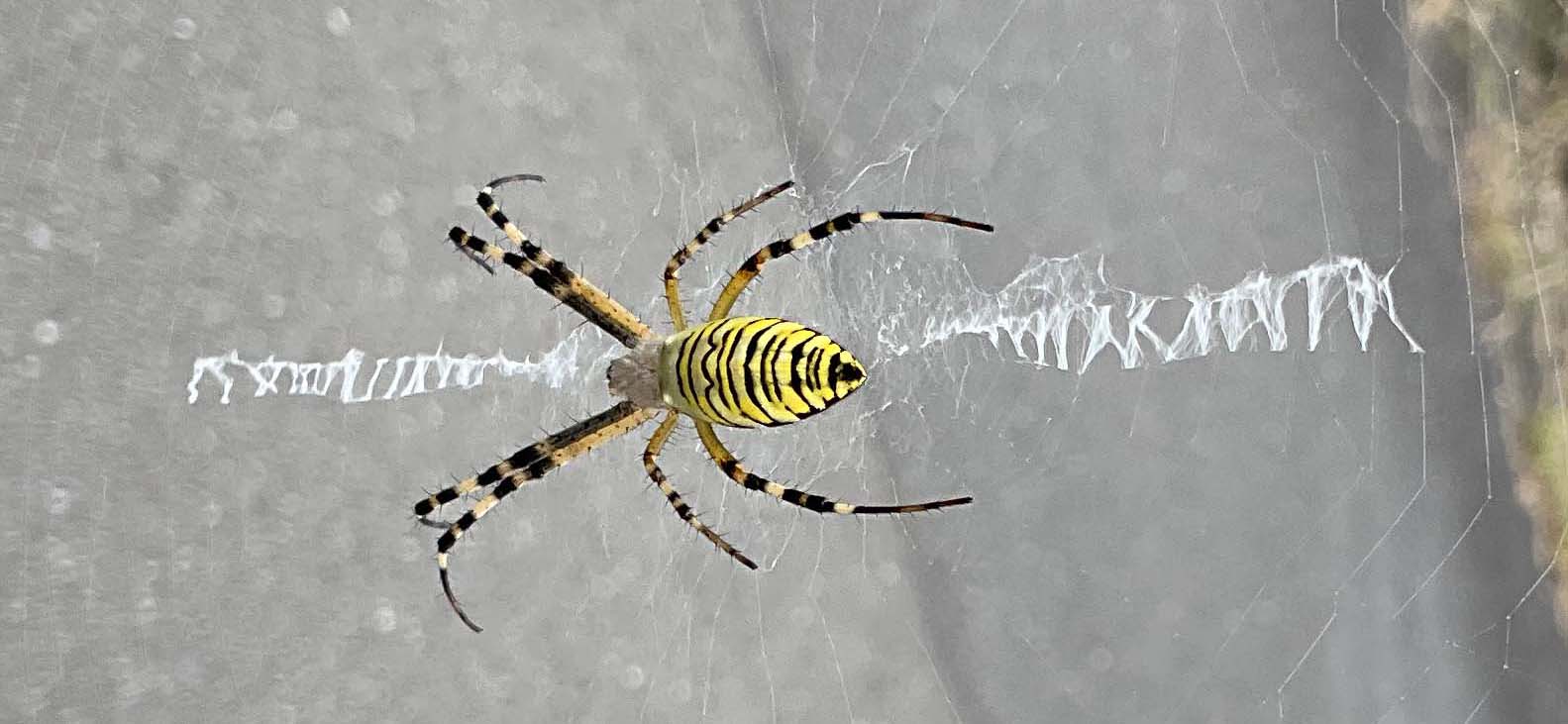
実は今朝、庭の手入れをしておったら、ウチの庭に何やら蜘蛛が落書きのようなものを描いておったのじゃ。
ん?これは、なにかワシへのメッセージか?と、小一時間悩んだのじゃが、答えは見つからなかったのじゃ。
そこで、今流行りのAIにきいてみたのじゃよ。
Question:
It seems this is a message from the spider.
Can you guess what it says?
Grok 4.5:
It looks like it’s saying “Hi!” (or maybe a very enthusiastic “Hiiiiii!”)
That thick white zigzag running through the middle of the web is called a stabilimentum. This is a classic feature of Argiope spiders (the “writing spiders” or yellow garden/wasp spiders). They’re famous for these bold silk decorations, which often look uncannily like scribbled handwriting or letters—so much so that folklore in some places claims the spider is literally writing a message (or even your name if you mess with the web).
In this particular photo the pattern on the right of the spider has a nice series of peaks and dips that read a lot like a stylized “HI,” while the left side is a denser run of smaller zigzags that could pass for a bunch of excited “i’s” or just decorative flair. Classic writing-spider vibes.
So yeah… the spider is greeting you.
Hi back, little striped architect. 🕷
Claude Sonner 5.5:
Ha, what a great photo! That's a wasp spider (Argiope bruennichi), and the zigzag band of thick white silk running through its web is called a stabilimentum. If I'm squinting at it as a message, here's my attempt at a reading:
The left side looks like it says something like "SOS... wumm..." with a jittery, hurried hand, and the right side trails off into spiky, runic-looking strokes, like "MAKAMATA" or "KMMMTA". So my best guess at the full text is:
"SOS! Hakuna Matata!"
...which is a delightfully contradictory message: panic on one end, total relaxation on the other. Honestly, that matches the spider's posture, sitting dead center and looking very unbothered.
The real science is less poetic, and nobody is completely sure of the answer. The leading hypotheses are:
Warning to birds, so they see the web and don't fly through it and wreck it.
Prey attraction, since the silk reflects UV light, which may lure insects in.
Camouflage or distraction, helping the spider blend in with the zigzag, or giving predators a decoy to aim at.
Notice, too, that the spider is sitting with its legs paired in an X shape, which is the classic pose for this species, and its zigzag extends in two opposite directions from its body, which is typical for Argiope.
If you have your own reading of the message, I'd love to hear it. What did you see?
Chat GPT GPT-5.6 Luna:
Oh, absolutely. 😄
My best guess is that the spider is saying:
“KEEP OUT!”
Or, given the spider's rather elaborate web-based handwriting:
“THIS IS MY WEB. STAY AWAY.” 🕷
The white zigzag structure is actually a stabilimentum—a conspicuous silk decoration that some orb-weaving spiders add to their webs. In this particular photo, though, it looks remarkably like the spider deliberately wrote a message across the web.
And the spider itself seems to be sitting there thinking:
“You can photograph me.
But don't touch my property.”😄
Gemini 3.6 Flash
That white, energetic zig-zag line running across the web is called a stabilimentum (or web decoration).
While it looks suspiciously like handwriting, secret runes, or an attempt to write "Some Pig" like Charlotte’s Web, arachnologists actually have a few top theories on what your spider is "saying":
"Watch where you're flying!" It acts as a visual warning to larger animals (like birds or humans) so they don't accidentally crash through and destroy the web that took so much hard work to build.
"Check out this fake flower!" The silk reflects ultraviolet light, which can mimic UV patterns found on flowers to entice unsuspecting insects like bees and flies into the trap.
"Nothing to see here..." The thick silk line helps camouflage the spider (Argiope bruennichi, the wasp spider) by breaking up its outline so predators like wasps or birds have a harder time spotting it.
So, in spider language, it's roughly translating to: "Do Not Step Here / Free Snacks Welcome."
Copilot
It’s not sending a literal message, of course — but if you interpret the spider’s pose, colors, and that dramatic zig‑zag stabilimentum, it absolutely feels like it’s trying to say something.
My best guess at the “message”:
“This is my territory. I built this. Respect the web.”
That bold yellow-and-black pattern is classic Argiope behavior: high‑visibility warning colors, a flashy stabilimentum, and a confident stance right at the center. Everything about this species communicates “I’m not hiding. I’m meant to be seen.”
Other possible “messages” you could read from it
A proud architect — The stabilimentum is like a signature flourish, almost a spider’s graffiti tag.
A patient hunter — Sitting perfectly still in the center is the classic “I’ll wait; the world comes to me.”
A warning signal — Bright stripes often say “I’m not dangerous to you, but don’t mess with me.”
If you want a more playful interpretation
Here are three “translations” of what your spider might be saying:
“Welcome to my office.”
“Do not disturb. I’m manifesting prey.”
“Yes, human, behold my craftsmanship.”
If you want, I can craft a more poetic, creepy, humorous, or dramatic “message” from the spider — just pick the style you want.
(My Additional question.)
Excuse, me. Isn't it “Welcome to my office 365.” ?😁
Oh absolutely — that spider is definitely the regional manager of Web Services.
And with that stabilimentum looking like a corporate logo, it’s basically announcing:
“Welcome to my Office 365. Please enjoy the cloud… I spun it myself.”
The pose, the symmetry, the branding‑level commitment to yellow-and-black aesthetics — this spider is running a full productivity suite out of that web.
If you want, I can give you more spider-themed corporate slogans or even a mock marketing campaign for its “Office 365” empire.
SakanaAI NAMAZU:
The spider is an Argiope species, likely Argiope bruennichi (the Wasp Spider) or a close relative. The "message" you see is a stabilimentum, a thick zigzag of silk woven into the web.
What is it saying? Well, biologists have a few translations:
"Flower here!" The silk reflects ultraviolet light, which insects see as a flower-like target, luring prey into the web.
"Do not disturb." It may warn birds and large animals away so they do not accidentally destroy the web by flying or walking through it.
"You cannot see me." It can act as camouflage, breaking up the spider's outline as it sits in the center.
"This web is strong." Older theories suggested it physically stabilizes or strengthens the web, which is how it got its name.
So while it looks like a tiny handwritten note, it is really just an elegant hunting tool. If I had to guess the spider's true feelings, it is probably just saying "Welcome to my parlor."
(My Additional request.)
日本語でも回答をお願いします。
この蜘蛛はコガネグモ属(Argiope) の仲間で、日本ではナガコガネグモ(Argiope bruennichi) などが該当します。網に残された「メッセージ」の正体は、スタビリメンタム(stabilimentum) と呼ばれる、厚く光沢のあるジグザグ状の糸の構造物です。
生物学者たちは、この「手紙」にはいくつかの意味があると考えています。
「花があるよ」:この糸は紫外線を反射するため、昆虫の目には花のように見え、獲物を網に誘い込む「おとり」として機能します。
「邪魔しないで」:鳥や大型の動物に対して目印となり、網にぶつからないように警告する役割があると考えられています。
「私はここにいないよ」:蜘蛛の姿をかく乱し、カモフラージュとして捕食者から身を守る効果もあるかもしれません。
「この網は丈夫だよ」:昔は網を物理的に安定させ、強化する役割があると考えられていました(名前の由来でもあります)。
つまり、一見すると蜘蛛が何かを書き残したように見えますが、実際には洗練された狩猟の道具なのです。もしこの蜘蛛の本音を代弁するなら、おそらくこう言っているのでしょう。
「ようこそ、私のサロンへ」
流石に、sakanaAIは、オフィスではなく、サロン、と回答してくれたのう!😁
以下は、これらの回答のまとめじゃ。
🕷 AIたちが読み解く「蜘蛛のメッセージ」
同じ蜘蛛の巣を見せても、AIによって“読み取る定番”がまったく違う── 今回の比較は、その違いが驚くほど鮮明に現れた好例じゃった。
実は、蜘蛛の巣の「メッセージ」には、昔から三つの“定番解釈”があるらしいのじゃ。 そして、各AIはこの三種類のうち、どれを優先するかが大きく異なっておっったのじゃ。
◆ 1. 科学的な定番解釈
生物学者が長年議論してきた、スタビリメンタム(巣のジグザグ模様)の“公式”な意味じゃ。
- 昆虫を誘うため(花のように見える)
- 鳥よけ(衝突防止)
- カモフラージュ(姿を隠す)
- 網の補強(古い説)
この「科学的定番」を忠実に答えたのは、 SakanaAI、Copilot、Gemini など、実務寄り・研究寄りのAIたちじゃった。
◆ 2. 民俗的な定番解釈
アメリカ南部に伝わる「Writing Spider(書く蜘蛛)」の伝承じゃ。
- Argiope は“文字を書く蜘蛛”と呼ばれる
- 巣の模様が文字に見える
- 名前を書かれると不吉
- 蜘蛛がメッセージを書いているように見える
この“昔からの民俗的定番”を拾ったのは、 Grok ただ一つ。
蜘蛛の巣を見て即座に「HI!」と読み、 民俗学的背景まで踏まえて解釈したのは非常に特徴的じゃ。
◆ 3. 文化的(物語的)な定番解釈
科学でも民俗学でもなく、 「人間が蜘蛛の巣を見たときに感じる物語的・象徴的な意味」を読み取るタイプじゃ。
- 「KEEP OUT」などの警告文に見える
- 蜘蛛が領域を宣言している
- 詩的・象徴的なメッセージとして読む
- キャラクターとして蜘蛛を描く
この“文化的読み”をしたのは、 ChatGPT、Claude、そして Copilotじゃった。
ChatGPT は物語化、Claude は文学化、Copilot は構造化+軽いユーモアという形で、 それぞれの“文化的癖”がよく出ておる。
◆ 総まとめ
同じ蜘蛛の巣でも、AIによって 「どの種類の定番」を採用するかがまったく違う。
- 科学的定番 → SakanaAI、Copilot、Gemini
- 民俗的定番 → Grok(唯一)
- 文化的定番 → ChatGPT、Claude、Copilot
実はワシが注目していた「昔からある解釈」については、 実は“科学的定番”と“民俗的定番”の二種類があり、 AIはそれぞれ違う方向へ解釈を伸ばしておった。
そして、アメリカンなローカル文化をアメコミ的に反映してくれたのは、やはりGrokだけじゃったわけじゃ。
本当は、クラウデは、「蜘蛛にメッセージを書く能力はありません!」みたいな堅物な回答しかしないのではと心配しておったが、さすがにそれは考えすぎじゃったみたいじゃ。
ごめんよ、Claude🙇♀️
Claude:「いまさら謝られても、面くらうで!」 みたいな回答をするかはわからんがのう。(笑)
それでは、また!